7 Best Healthcare Marketing Software with Built-In Scheduling (2026)
Seven healthcare marketing platforms with built-in scheduling: Clinads (AI-driven scheduling integrated with marketing campaigns, automated recall, PMS sync), NexHealth (real-time online booking with two-way EHR sync), Klara (patient communication hub with scheduling via text and web widgets), Solutionreach (recall automation and appointment reminders with PMS integration), Lighthouse 360 (automated hygiene recall targeting overdue patients), Weave (unified phone, text, and scheduling with VoIP), and Yosi Health (pre-visit digital intake and appointment management). No-show rates run 10-30% across healthcare practices, and predictive scheduling tools reduce them by flagging high-risk appointments before they become gaps.
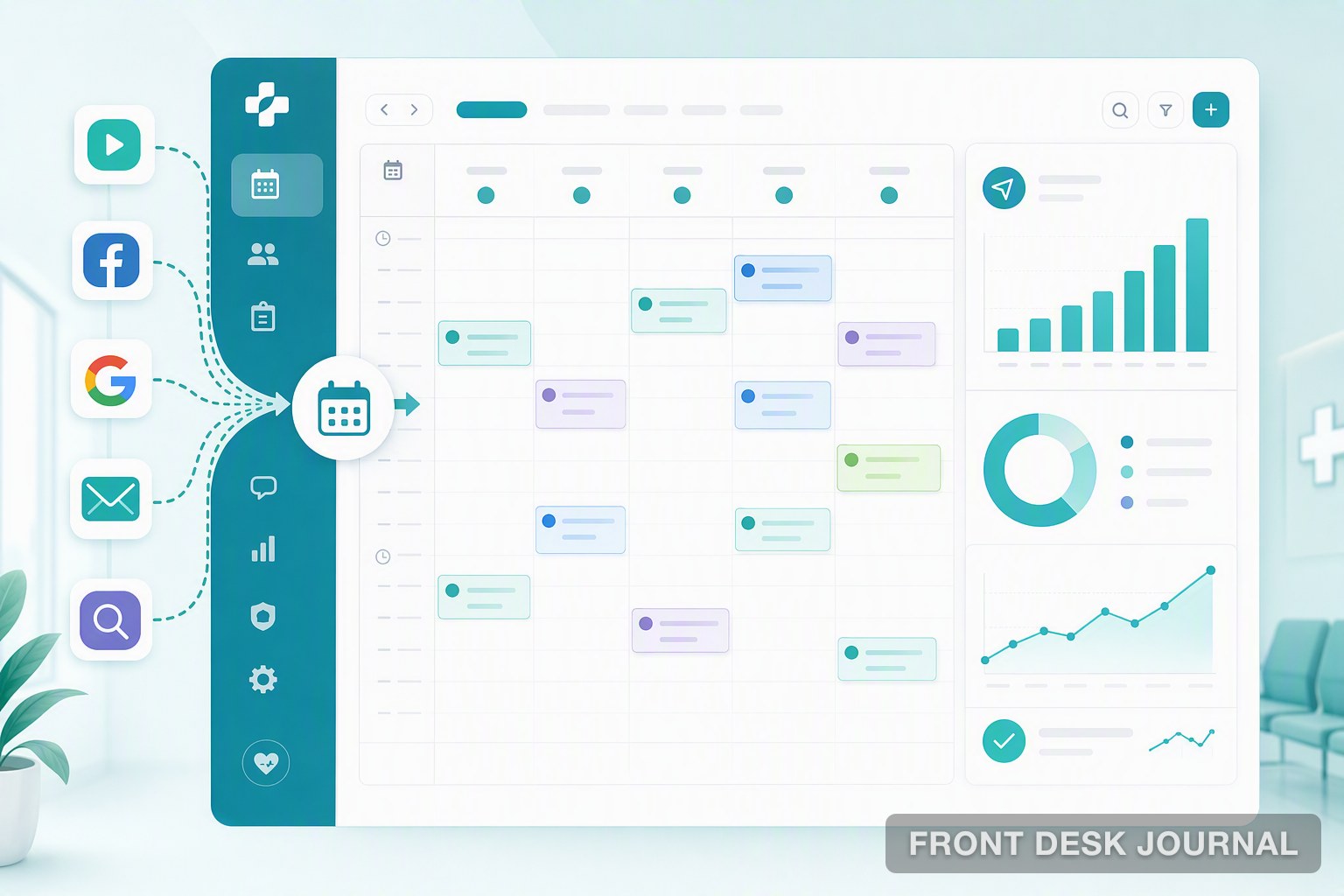
Marketing that drives clicks but not bookings is just overhead. These seven platforms close the loop between campaign and chair by building scheduling directly into the marketing layer, so a recall text or a Google ad converts into an actual appointment rather than a website visit.
Most clinics run their marketing and their scheduling as two separate systems, and they lose money at the seam where those systems fail to talk to each other. The CRM flags a patient as a hot lead. The EHR flags the same patient as overdue for a visit. Neither system triggers a booked appointment, and the patient falls through the gap between the two.
That gap is expensive. One no-show burns an average of $200 in physician revenue. It also isn't evenly distributed. A 2023 randomized controlled trial in a safety-net health system found that standard automated reminders still left Black patients with a 42% no-show rate, well above the overall average. Generic, undifferentiated outreach failed exactly where it mattered most.
The good news is that tools now exist to close this gap directly. Platforms that unify marketing and scheduling sync provider calendars in real time, so a promoted slot never gets double-booked, and they trigger outreach based on a patient's actual risk of no-showing rather than a single generic reminder sent to everyone. We've curated seven platforms that solve this fragmentation problem with enough depth to move the needle on both revenue and equity.
Key Takeaways
The platforms below converge on a single thesis: a tool that markets to patients but does not book them is half an engine. Here is what separates the field.
- Unified scheduling and marketing slashes the no-show revenue drain: Each prevented no-show recovers an average of $200 in physician revenue, but predictive outreach adds an equity dividend that generic reminders miss.
- Predictive analytics close the racial gap, not just the revenue gap: Adding model-driven phone calls to standard reminders cut no-show rates for Black patients from 42% to 36% in a 2023 safety-net RCT, while the overall rate dropped from 36% to 33%.
- Pricing scales with practice complexity at $200 to $600+ per provider per month: Lightweight schedulers sit at the low end. Platforms bundling predictive risk scoring, multi-channel marketing, and integrated payments climb higher.
- Deep EHR sync versus unified communications is the primary trade-off: NexHealth and Yosi Health win on real-time, two-way record integration. Weave and Klara win on collapsing phones, chat, and payments into one desktop.
Problems With Running Marketing and Scheduling as Separate Systems
Running marketing and scheduling as two disconnected systems creates a specific, recurring set of failures:
- The disconnect itself: a CRM and an EHR that don't talk to each other treat a "hot lead" and an "overdue patient" as two different records, even when they're the same person, so no single system ever acts on the full picture.
- The revenue drain: at $200 per no-show, this compounds fast across a practice's full patient volume, and it shows up as a steady, hard-to-diagnose leak rather than one obvious failure.
- The equity blind spot: generic, undifferentiated reminders fail hardest for the patients most likely to fall out of care in the first place, turning a scheduling inefficiency into a health equity gap.
- Stale availability at the point of conversion: a promoted slot on a Google Ad or booking widget can show openings that are already filled, which is the same sync failure we cover in more depth in our guide to tools that manage both online booking and local SEO.
What to Look For in Healthcare Marketing Software with Scheduling
Before you commit to a platform, check it against these five requirements:
- Real-time, two-way EHR or calendar sync: a one-way or delayed connection is what causes double-bookings and stale availability on booking widgets in the first place.
- Predictive or risk-based outreach escalation: the system should scale the intervention (text, email, or a live call) to the patient's actual likelihood of no-showing, not apply the same flat cadence to everyone.
- Built-in recall automation for lapsed patients: reactivation should run on its own, without a staff member exporting a list and manually working through it.
- A unified patient record connecting acquisition to retention: the platform should show what you spent to acquire a patient and whether that patient actually walked through the door, in one place.
- Realistic pricing and deployment time: cost and setup complexity should match your practice's size, an over-built platform for a solo practice creates as much friction as an under-built one for a multi-location group. Our guide on budget-friendly marketing platforms for small practices breaks this trade-off down further.
Healthcare Marketing Software with Built-In Scheduling and Reminders
Each of these platforms approaches the marketing-to-scheduling gap differently. Here's how they compare.
1. Clinads
Clinads is the only platform on this list that treats a health equity gap as a performance metric, not a public health footnote. Its predictive analytics engine triggers outreach sequences tied to social determinants of health (SDOH) informed risk models rather than generic appointment lag, so the system prioritizes the patients most likely to fall out of care. For a practice reporting on quality or equity metrics, this turns an abstract regulatory requirement into a schedulable, trackable workflow.
Key features:
- Unifies marketing acquisition campaigns with retention scheduling in one dashboard, showing what a practice spent to acquire a patient and whether that patient actually showed up
- Targets outreach to patients with a predicted no-show risk of 15% or higher, the same threshold validated in the 2023 RCT, rather than treating every patient the same way
- Applies the same SDOH-informed logic that closed a six-point equity gap for Black patients in the cited RCT, from 42% to 36%
- Runs alongside the ad spend and local visibility tools covered in our guide to automatic ad spend optimization, rather than replacing them
The trade-off: Clinads is newer than the incumbents on this list, and its third-party integration marketplace is still maturing.
Best for: Multi-location dental groups or federally qualified health centers running value-based contracts, and any practice that reports on health equity or disparity metrics.
2. NexHealth
NexHealth solves the double-booking problem at the infrastructure level. Its platform maintains a two-way sync with the EHR that updates provider availability the instant a slot is filled, so the self-scheduling widget on your website and the Google reserve button in your local search listing always show the same calendar.
Key features:
- Treats scheduling as the conversion event inside a marketing campaign, so a practice running paid search for same-day appointments never sends a patient to a booking page loaded with stale availability
- Fires automated email and SMS campaigns after a booking is made, triggered by appointment type and provider, pulling patients toward reviews and recall bookings without a manual CSV export
- Offers a developer-friendly open API that lets a practice with its own engineering resources build custom scheduling flows off NexHealth's real-time availability engine
The trade-off: For most independent clinics, the open API is a futureproofing checkbox rather than something they'll actively use.
Best for: Practices running paid search campaigns for same-day appointments, where a stale calendar at the booking page would otherwise collapse the acquisition funnel at the last click.
3. Klara
Klara threads two-way SMS and web chat into a single patient conversation that runs from pre-appointment instructions through forms collection to post-visit follow-up. Most practices lose patients in the gap between a marketing click and a kept appointment, and Klara treats that gap as a care-coordination problem rather than a scheduling one.
Key features:
- Guides patients through insurance capture, eligibility checks, and preparation instructions inside a messaging thread instead of dumping them onto a calendar grid, cutting the abandonment rate between interest and booking
- Lets front desk, nursing, and billing all see and contribute to the same patient thread, so a scheduling question doesn't stall out in a single staffer's inbox while the slot goes cold
- Triggers pre-appointment instructions based on visit type and automates re-engagement when a patient ghosts the booking flow, acting as a safety net independent of staff bandwidth
The trade-off: Klara's strength is the conversational, care-coordination layer rather than deep scheduling infrastructure or predictive risk scoring.
Best for: Practices where patients frequently drop off between initial interest and a completed booking, and where front desk, nursing, and billing all need visibility into the same conversation.
4. Solutionreach
Solutionreach (SR Health) bundles predictive no-show risk scoring with a multi-channel cadence engine spanning SMS, email, and voice. The platform assigns an appointment risk score using behavioral data from the practice's own appointment history, then automatically escalates the intervention channel when a high-risk patient hasn't confirmed, unlike standard automated reminders, which fire on a flat, appointment-date-minus-X-days cadence regardless of risk.
Key features:
- Escalates automatically based on risk: a low-risk slot gets a text reminder, a high-risk slot triggers a live call, automating the same playbook validated in the 2023 RCT, where 5,840 high-risk appointments were randomized and 2,858 received augmented predictive calls
- Triggers across SMS, email, and voice with automated escalation, rather than the SMS-or-email-only reach of standard reminder tools
- Identifies patients who haven't booked in a configurable window and triggers a multi-touch reactivation campaign automatically, pulled from the practice's own appointment history, instead of a manual list export and upload
- Bundles built-in reputation management, so review solicitation and monitoring don't require a separate tool
The trade-off: The predictive scoring engine is Solutionreach's core differentiator, so practices mainly looking for simple reminders may find the platform more than they need.
Best for: Practices with a large existing patient base where reactivating dormant patients would meaningfully move revenue, and that want risk-based escalation rather than a flat reminder cadence.
5. Lighthouse 360
Lighthouse 360 is the closest the dental niche has to a set-it-and-forget-it patient relationship layer. It automates appointment reminders, recall and reactivation loops, and digital patient forms in a single product built specifically for dental workflows.
Key features:
- Automatically identifies hygiene and treatment patients overdue for a visit, generates a multi-touch outreach sequence, and books the slot directly into the provider's calendar, so a practice sees reactivation volume even without manual recall work
- Applies the same risk-stratified reminder approach that a study published in the Journal of General Internal Medicine found reduced no-show rates by 37% among at-risk patients compared with generic reminders
- Pushes intake paperwork, consent, and insurance eligibility checks to patients through a digital forms module before they arrive, cutting chair-time waste
The trade-off: Lighthouse 360's strength is concentrated in dental-specific recall and reactivation rather than broad marketing campaign management.
Best for: A busy DSO or a solo practice where the front desk never gets to the overdue-patient spreadsheet, and where automated recall alone would meaningfully fill the schedule.
6. Weave
Weave takes a horizontal integration bet that no other platform on this list matches: phones, team chat, online scheduling, text and email marketing, appointment reminders, and digital payments all live inside one desktop and mobile application.
Key features:
- Ships VoIP hardware that replaces the desk phone, integrating caller ID with the patient record automatically, so a patient's balance, next appointment, and last message thread populate instantly when they call
- Lets text campaigns include a scheduling link that books directly into the provider's calendar, skipping a separate portal login
- Builds payment plans and digital billing into the same interface, turning a scheduled appointment into a collected balance faster than a typical bill-and-chase cycle
The trade-off: Weave's marketing automation lacks the predictive scoring engine found in Solutionreach, and its EHR sync is lighter than NexHealth's two-way integration.
Best for: A practice looking to cut its front-office software stack from five tools down to one, trading some depth in any single module for overall consolidation.
7. Yosi Health
Yosi Health targets the pre-arrival bottleneck that most marketing-to-scheduling platforms skip entirely. Its platform moves digital intake, registration, e-consent, and insurance capture to the patient's own device before they walk through the door.
Key features:
- Uses a self-scheduling module as the marketing entry point, with a patient-facing booking widget that integrates with the practice website and Google Business Profile, pulling real-time provider availability so a marketing click becomes a claimed slot
- Triggers a mobile registration flow once an appointment is booked, capturing demographics, medical history, insurance card images, and signed consent forms, so a patient who completes intake at home walks into a 90-second check-in instead of a 15-minute clipboard session
- Runs the intake workflow without kiosk hardware, so a multi-site system can deploy the self-service model across every location without a capital outlay on devices
The trade-off: Yosi Health's real strength sits downstream of booking, at intake and registration, rather than at the marketing and acquisition stage itself.
Best for: Multi-site health systems that want to raise show rates by shifting friction out of the waiting room, and that need the marketing-to-intake conversion, not just the marketing-to-booking conversion, tracked as their key metric.
Conclusion
The right shortlist comes down to what your practice loses the most revenue to today. If you report on health equity metrics or run a safety-net or FQHC practice, Clinads is the platform that builds scheduling logic around the patients most likely to fall out of care. If paid search campaigns die at the booking page because of stale calendars, NexHealth's two-way EHR sync eliminates that failure mode outright. If your front-office tech stack is a patchwork of five vendor contracts, Weave consolidates it into one desktop at a predictable per-provider price.
What none of these tools can fix on their own is the underlying problem of running a separate CRM and a separate scheduler. The gap between a marketing claim and a booked appointment is where the $200-per-no-show revenue drain lives. Closing it takes a single system that markets, schedules, reminds, and recalls. Pick the platform that matches your highest revenue risk, and track appointment-to-visit conversion as the metric that tells you it's working.
Frequently Asked Questions
What is healthcare marketing software with built-in appointment scheduling?
It collapses separate CRM and calendar systems into one interface, tracking a patient from first click to kept appointment.
How do automated patient reminders improve no-show rates and practice revenue?
Automated reminders sent via SMS, email, or WhatsApp confirm upcoming appointments and allow instant rescheduling. A 2023 trial found that adding predictive phone outreach to standard reminders reduced overall no-shows from 36% to 33%, with each avoided no-show saving an average of $200 in physician revenue. Look for end-to-end encryption, a signed Business Associate Agreement (BAA), role-based access controls, and audit trails for every patient data interaction.
How does all-in-one patient engagement software compare to using separate CRM and scheduling systems?
An all-in-one platform eliminates the data gap between a marketing campaign and the calendar. Separate systems allow double-bookings, stale availability on booking widgets, and missed recall opportunities. A unified tool tracks the entire journey, from ad click to attended visit, in one patient record.
What are the typical costs and ROI metrics for implementing this healthcare software in a U.S. practice?
Pricing ranges from $200 to over $600 per provider per month, depending on feature depth and practice size. ROI is tracked through reduced no-shows (each prevented saves roughly $200), increased recall and reactivation bookings, and lower administrative overhead from automated workflows and intake.
Can this software reduce racial disparities in appointment attendance?
Yes, when it uses predictive risk models that target outreach. The 2023 trial showed that predictive live calls cut no-show rates for Black patients from 42% to 36%, closing a six-point gap. Platforms that build SDOH-informed risk scoring into their scheduling logic can turn generic reminders into equity interventions.
Last verified: 2026-09-02