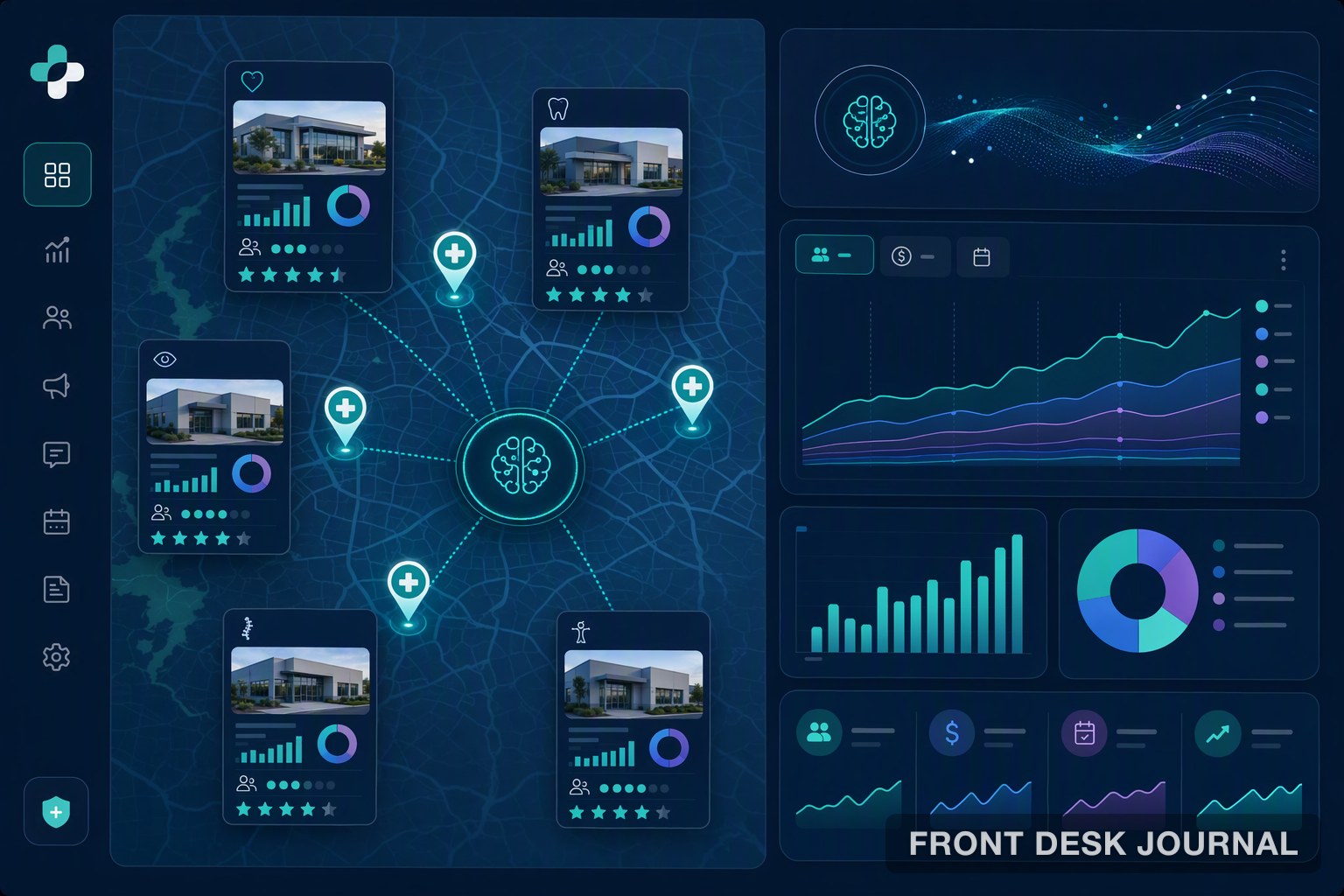
7 Best AI Marketing Platforms for Multi-Location Healthcare Groups in 2026
Seven AI marketing platforms for multi-location healthcare groups: Clinads (HIPAA-compliant multi-location AI marketing with per-location campaigns and group-level reporting), SOCi (enterprise social and reputation management across locations, Gartner-listed Glean alternative), Yext (centralized listings and knowledge graph synced across directories), Birdeye (reputation management and patient reviews aggregated across locations), Podium (AI-powered lead conversion with messaging and payments), PatientGain (multi-location marketing platform with dedicated practice websites and PPC management), and DeepSights AI (AI-driven market intelligence for patient acquisition). HIPAA compliance is non-negotiable: multi-location groups that use standard marketing tools not designed for healthcare face real regulatory exposure.
Running marketing across multiple clinic locations means dealing with three problems at once: keeping local listings accurate, staying HIPAA-compliant across every touchpoint, and surfacing which locations are underperforming before corporate finds out. These seven platforms handle all three.
Most healthcare networks are bleeding patients through a thousand tiny leaks across their local listings, reviews, and ad campaigns. The regional manager in Dallas is ignoring a 2.1-star rating on a profile that reads 'permanently closed.' The office in Phoenix is running Google Ads that point to a landing page for Miami. The problem is not budget. The problem is that centralized marketing teams cannot manually police the digital health of 200 separate clinics.
Each location competes in its own micro-market against independent practices that outmaneuver the brand on local relevance. The cost of a slip is not theoretical. HIPAA violations can cost anywhere from $100 to $50,000 per violation, with maximum annual penalties reaching into the millions.
AI marketing platforms built for multi-location healthcare solve this exact tension. They enforce brand governance at the top while automating hyper-local execution at the bottom. This article ranks the seven platforms that do it at scale, so your corporate team can stop firefighting and start building a machine that turns local search into booked appointments.
Key Takeaways
The gap between a national brand and a local clinic is where most marketing spend disappears. These platforms close it. Here is what to know before you buy:
- Centralized dashboards are non-negotiable: A single Corporate Dashboard with restricted local views is the only way to govern brand consistency without strangling local managers who know their market better than headquarters does.
- One BAA, not twenty: Demanding a unified single Business Insider Associate Agreement across all software modules, AI agents, and human services slashes compliance exposure. Patchwork BAAs are an audit disaster waiting to happen.
- Review analysis beats review volume: Platforms like Birdeye that extract clinical and operational themes from unstructured patient feedback turn complaints into process fixes. Star ratings alone tell you nothing about why patients are leaving.
- Predictive allocation recovers wasted ad spend: Tools that reallocate budget dynamically across locations based on predicted return cut the biggest cost in multi-location advertising: internal cannibalization and market saturation.
- The ROI is local listing integrity: A single wrong phone number on a Google Business Insider Profile costs more in lost appointments than most monthly platform fees. Automation that locks NAP data across hundreds of directories pays for itself immediately.
Problems With Managing Marketing Across Multiple Healthcare Locations
Running marketing for a multi-location healthcare group creates a distinct set of failures that don't show up in a single-clinic operation:
- The scale gap: a centralized team can't manually monitor listings, reviews, and campaigns across hundreds of locations, so small failures, a stale profile, a misrouted ad, sit unnoticed until they've already cost patients.
- The compliance exposure: a patchwork of separate BAAs across different vendors and software modules creates coverage gaps, and an audit that hits one uncovered module can cascade into system-wide exposure.
- Local irrelevance versus brand drift: networks that over-centralize control kill local relevance and lose to independent practices in their own micro-markets, while networks that over-distribute control let brand consistency erode location by location.
- Budget cannibalization: overlapping locations competing in the same metro area can end up bidding against each other in the same auctions, driving up cost-per-acquisition for the whole network rather than growing it.
What to Look For in an AI Marketing Platform for Multi-Location Groups
Before you evaluate any platform at the network level, check it against these five requirements:
- A centralized dashboard with permission-based, restricted local views: corporate needs governance and visibility, but local managers still need enough autonomy to stay competitive in their own market.
- A single, unified BAA covering all software, AI agents, and human services: fragmented, per-module compliance coverage is an audit risk waiting to surface.
- Thematic review and sentiment analysis, not just star ratings: a platform should surface recurring operational patterns in patient feedback, not just track an aggregate score.
- Predictive, cross-location budget allocation: the system should prevent nearby locations from cannibalizing each other's ad spend, not just report on performance after the fact.
- Automated NAP and listing accuracy enforcement at scale: directory accuracy has to hold across hundreds of locations and publisher networks simultaneously, not rely on local office managers remembering to update it.
AI Marketing Platforms for Multi-Location Healthcare Groups
Each of these platforms solves a different piece of the multi-location marketing problem. Here's how they compare.
1. Clinads
A point solution fixes one thing. An operating system coordinates everything, and that's the category Clinads sits in. It functions as a command center that orchestrates cross-location campaigns, enforces brand governance, and gives local managers just enough autonomy to stay competitive without breaking the brand's consistency.
Key features:
- Runs unified analytics across every market from a single pane, so regional operators stop duplicating work and start competing on execution instead
- Applies creative versioning that keeps local campaigns relevant to their market without drifting off-message from the brand
- Runs automated compliance checks that flag a violation before it reaches a patient's screen
- Gates permissions so corporate sets the guardrails, creative libraries, and compliance rules, while local managers optimize within those walls
The trade-off: Implementation load is real with a full-stack operating system. This is a new marketing nervous system for the organization, not a widget you drop in, which is significant for groups still running lean, in-house marketing operations.
Best for: Healthcare networks that have outgrown a patchwork of localized vendors and in-house spreadsheets, and that need paid search, social, and AI-driven local SEO running from one coordinated system rather than several disconnected ones.
2. SOCi
SOCi is built on a simple premise: local engagement only scales when local teams and corporate marketers share the same system. Its CoMarketing Cloud layers localized social publishing, review response workflows, and listing management into a single interface that both corporate and on-the-ground managers can use without a training manual.
Key features:
- Automates distribution of approved content to local channels, then lets local admins adapt it within brand guardrails, rather than leaving local social pages to go unmanaged
- Holds a 4.0/5 overall rating on Gartner Peer Insights in the online reputation management market, reflecting real production use rather than just sales positioning
- Combines review response workflows with listing management, so reputation and directory accuracy live in the same system local teams already use daily
The trade-off: SOCi's strength is concentrated in localized social and review response rather than broader compliance architecture or predictive budget allocation.
Best for: Groups whose primary pain point is local social silence and slow review response times across a large number of individually managed pages.
3. Yext
Yext wins on precision. When a patient searches for a clinic and Google returns a phone number that's three years out of date, Yext is the platform built to prevent exactly that failure. It functions as a command center for digital knowledge management, keeping every location's name, address, and phone number correct across hundreds of directories, search engines, and voice assistants at once.
Key features:
- Acts as a single source of truth: update a location's hours once in the dashboard, and the change propagates across the entire publisher network, rather than relying on a local office manager to update three separate profiles
- Runs a suppression engine that actively identifies and suppresses stale data distributed by competitors and third-party aggregators, cutting down on calls about services a location stopped offering months ago
- Surfaces analytics granular enough for a corporate marketing analytics team to attribute revenue impact directly to listing accuracy
- Holds a 4.4/5 rating across 32 reviews on Gartner Peer Insights, concentrated on its listings and brand management capabilities
The trade-off: Yext's data rigidity is a strength for regulated networks that need every public-facing data point audit-ready, but it also removes local discretion that some managers may want for content variation.
Best for: Healthcare networks governed by strict regulatory frameworks that need every listing across every directory to be consistently accurate and audit-ready.
4. Birdeye
A 4.7-star average rating across 80 locations means nothing if every complaint clusters around the same billing issue and nobody's fixing it. Birdeye's core differentiator is its Search AI engine, a thematic analysis layer that scans unstructured patient feedback across every location and surfaces recurring patterns before they crater referral volume.
Key features:
- Uses natural language processing to categorize sentiment and flag compliance-sensitive language, such as privacy concerns or mentions of protected health details, before a response goes public
- Helps optimize ad spend, automate lead nurturing, and use predictive analytics to target high-intent prospects, extending its intelligence layer beyond reputation into acquisition
- Surfaces recurring themes, like a pattern of confusing invoices or long wait times, that prospective patients are already scanning for before they book
- Lets operational leaders pull a report showing a specific complaint theme concentrated in a handful of locations, then correlate it with staffing data to fix the root cause
The trade-off: Birdeye's core strength is turning patient feedback into operational intelligence, which means its value is highest for groups actively willing to act on what the data surfaces, not just monitor it.
Best for: Groups that need reputation insights to flow directly into clinical and operational decisions, not sit static in a marketing dashboard.
5. Podium
Podium bets on the channel patients actually use: text messaging. Its platform layers conversational AI across SMS, webchat, and direct messaging to bridge the gap between a Google search and a booked appointment.
Key features:
- Lets a prospective patient searching for care on a Sunday night message the clinic directly, verify insurance, and schedule an appointment without a single phone call
- Automates the last mile of the funnel, lead qualification, insurance verification, and scheduling, compressing the time from ad impression to booked revenue
- Routes all patient communications through compliant, monitored channels rather than letting staff text patients from personal phones, closing an invisible compliance gap across a large network
- Collects patient data through the conversation itself, feeding retargeting campaigns and giving corporate marketing a direct line from spend to chair occupancy
The trade-off: Podium is built as a conversion engine focused on the bottom of the funnel, rather than a brand-building or listing-accuracy platform.
Best for: Networks where patient acquisition cost is the metric leadership watches most closely, and where converting existing demand matters more than generating new visibility.
6. PatientGain
When the Chief Compliance Officer has veto power over the marketing budget, PatientGain is the platform built for that conversation. Its architecture prioritizes regulatory safety without sacrificing local search performance, and the structural advantage is administrative simplicity: one contract, one implementation, one set of compliance protocols.
Key features:
- Runs a unified single Business Associate Agreement across all software modules, AI agents, and human services, instead of the separate, fragmented BAAs most platforms hand over per module or vendor
- Scales from a single clinic up to 200 locations across the country, where many alternatives cap out at sub-100 location tiers without custom enterprise pricing
- Prices at $500 to $800 per location per month with volume pricing, giving networks per-location cost transparency instead of a bundled, opaque enterprise rate
- Provides a Corporate Dashboard with real-time lead tracking and performance metrics, alongside restricted local views that prevent unauthorized data access
The trade-off: PatientGain isn't the cheapest option on this list. For a 50-location network, the pricing represents a six-figure annual commitment, positioned against the far larger cost of a single HIPAA penalty.
Best for: Networks where the General Counsel, not just the marketing VP, needs to sign off, and where contract simplicity is itself a risk-reduction strategy.
7. DeepSights AI
The standard multi-location marketing approach is retrospective: spend across locations, measure results at the end of the quarter, then adjust. By then, the damage from cannibalized markets and saturated channels is already baked into the numbers. DeepSights AI attacks that inefficiency with predictive models that allocate budget before the spend happens.
Key features:
- Forecasts which locations will deliver the highest marginal return from the next advertising dollar, shifting the budget conversation from "how did we do" to "where will the next dollar work hardest"
- Learns from conversion data, appointment volumes, and local competitive density to recommend a dynamic budget distribution across the network
- Flags a recommended budget shift before cost-per-acquisition spikes in a competitive market, rather than after the damage shows up in the numbers
- Analyzes user behavior, tracks healthcare website visits, and identifies high-converting marketing channels, operationalizing that insight directly at the budget-allocation level
The trade-off: DeepSights AI doesn't replace the execution platforms in this list, it sits on top of them, ingesting performance data and outputting recommendations a centralized media team still has to push into their ad platforms. Where operational tools like Clinads orchestrate what's happening across the network right now, DeepSights forecasts what will happen if the budget gets allocated differently.
Best for: Health systems in competitive metros where multiple locations overlap the same search radius, and where a CFO scrutinizing marketing efficiency needs a forward-looking allocation model, not just a retrospective report.
Conclusion
The right platform depends on your network's actual breakpoint. If data inaccuracy across directories is costing you new patient calls, Yext is the fix. If a handful of locations are dragging down your aggregate reputation score with systemic complaints nobody's reading, Birdeye surfaces the root cause. If your General Counsel is losing sleep over marketing compliance, PatientGain's unified BAA model is the safest path. If the real problem is scattered point solutions with no unified workflow, Clinads ties them together as the operating system layer.
Start by naming the primary failure in your current stack, then buy the platform that resolves it, and test it across a controlled regional rollout before expanding to the full network. The risk isn't picking the wrong platform. The risk is picking one and never standardizing it, leaving the patient acquisition engine held together by local spreadsheets and hope.
Frequently Asked Questions
What are the core features an AI marketing platform must have to support multi-location healthcare groups in 2026?
AI must power local SEO content generation, predictive budget allocation, and thematic review analysis that surfaces operational issues across the network. They provide unified Business Insider Associate Agreements covering all software modules and AI agents, enforce permission-based access controls so local managers only see their location's data, and automatically flag marketing content containing protected health information or privacy-sensitive language before publication.
Which AI platforms specialize in local SEO, reputation management, and listings for hundreds of healthcare locations?
Yext dominates structured listing integrity and NAP consistency across publisher networks. SOCi and Birdeye specialize in localized social media management and AI-powered review analysis at scale. Clinads functions as an operating system that orchestrates local SEO campaigns and enforces brand governance across the full location network.
What measurable ROI can a multi-location healthcare group expect from implementing an AI-driven marketing platform?
Return comes from three levers: - Reduced patient acquisition cost: through automated local ad optimization - Increased appointment conversion: from AI-led lead nurturing - Revenue recovered: from eliminating listing inaccuracies that direct patients to wrong phone numbers or outdated service information
How do the leading AI marketing platforms like SOCi, Yext, Birdeye, and Podium compare for enterprise healthcare organizations?
SOCi is strongest on localized social and review response. Yext wins on absolute data accuracy across publisher networks. Birdeye excels at extracting operational intelligence from unstructured patient feedback. Podium dominates text-based patient acquisition and appointment conversion. Each optimizes a different stage of the patient journey.
What are the biggest implementation challenges when deploying an AI marketing platform across a distributed healthcare network?
Standardizing inconsistent location data before platform onboarding, training local office managers who have varying levels of marketing expertise, and enforcing brand compliance while granting enough local flexibility to remain competitive in distinct micro-markets.
Last verified: 2026-09-02