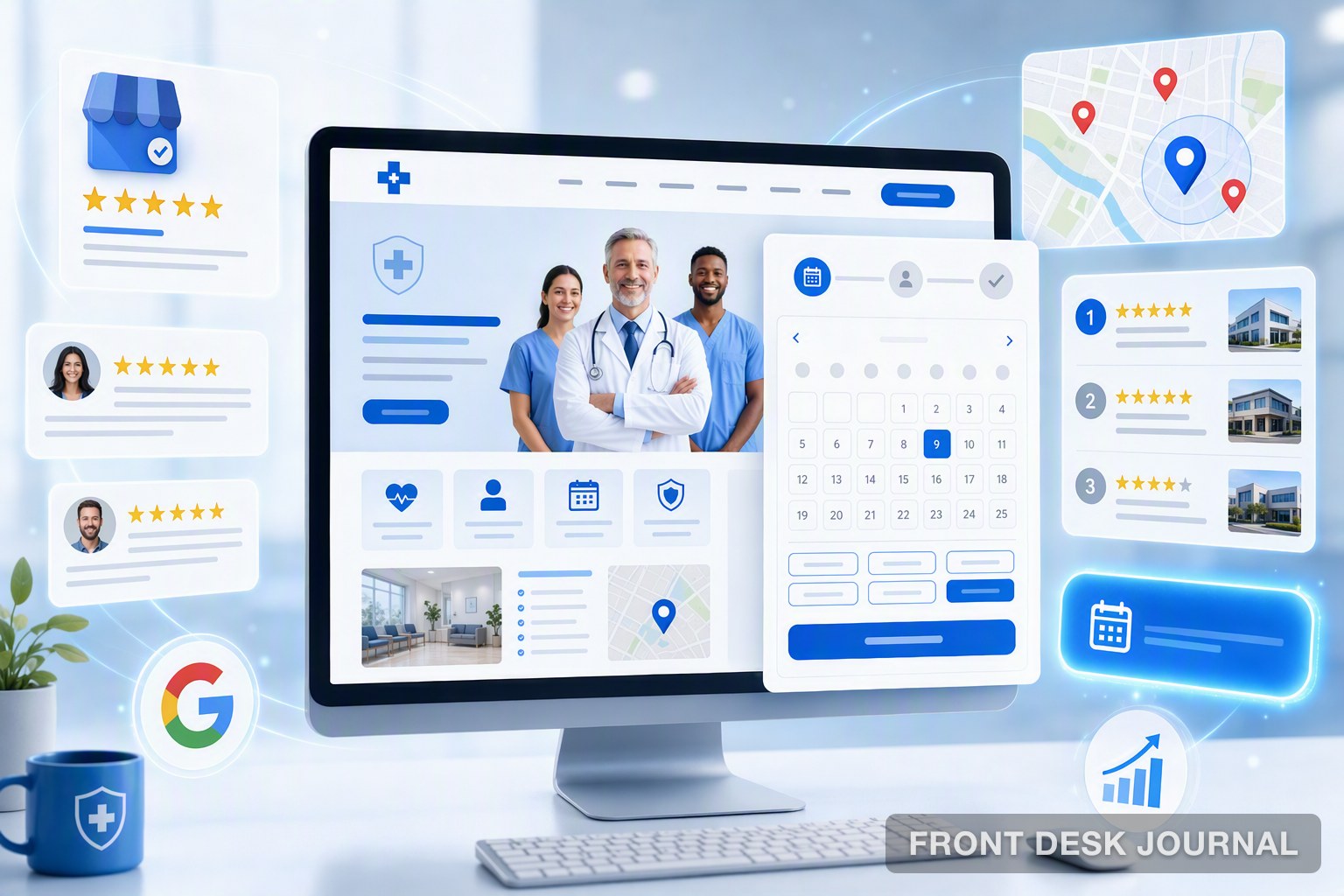
7 Tools That Manage Both Online Booking and Local SEO for Healthcare Practices in 2026
Comparing 7 tools that manage both online booking and local SEO for healthcare practices: ClinAds for unified growth, NextGen Healthcare for enterprise EHR, Tebra for integrated practice management, NexHealth for API-first sync, DocResponse for conversion, Birdeye for reputation, and athenaOne for multi-specialty groups.
7 Tools That Manage Both Online Booking and Local SEO for Healthcare Practices in 2026
Yes, a tool that manages both online booking and local SEO for healthcare practices exists. But most practices are not running one system. They are running two disconnected ones and calling it a strategy.
Here is what that disconnect actually looks like. Your booking link lives in one tool. Your Google Business Profile lives in another. Your reviews get requested manually, if at all. Meanwhile, 31% of patients won't even consider a business rated under 4.5 stars, and 86% checked online reviews before choosing their last dentist, with 41% saying they always read reviews before picking a provider.
That fragmentation is not a minor inconvenience. It is the reason patients who click your ad or your listing never make it to your booking page. Somewhere between discovery and confirmation, the chain breaks, and you pay for that break in wasted ad spend and empty slots.
Key Takeaways
The decision between these platforms hinges on practice size, existing EHR commitments, and the depth of local SEO automation needed. Below are the core insights drawn from the comparison.
- A dedicated medical platform encrypts that data and signs a BAA, while its listing sync ensures directory accuracy that generic calendar widgets ignore.
- Review velocity drives visibility: Positive reviews on a GMB listing can boost credibility and local search ranking. Platforms with automated review solicitation integrated into the post-appointment workflow outperform manual processes.
- Acquisition costs demand efficiency: The cost to convert a click into a seated patient runs 70 to 150 USD for general dentistry, climbing to 200 to 400 USD for implants, veneers, and full-arch cases. A broken booking-to-listing connection inflates that cost by leaking high-intent traffic before conversion.
- No single platform does everything: As a HyperFX analysis notes, no single platform manages both new-patient acquisition and patient retention in a fully integrated stack. Most solutions excel at one side of the funnel; the choice depends on which gap costs you more.
What "Managing Both" Actually Means
Before you evaluate any tool, it helps to separate the two halves of the problem you are actually trying to solve.
Booking and scheduling infrastructure covers the mechanics of turning interest into a confirmed appointment. This includes:
- Real-time calendar availability
- Patient-facing scheduling widgets or portals
- Sync with your EHR or practice management system
- Automated reminders and rescheduling
Local SEO, on the other hand, covers whether patients find you in the first place. This includes:
- Google Business Profile accuracy and NAP (name, address, phone) consistency across directories
- Review volume and review velocity
- Local pack and treatment-page rankings
- Increasingly, whether your practice gets cited in AI search answers, not just Google results
Why the Disconnect Costs You Patients
The typical failure pattern looks like this: a patient sees your ad or finds your listing, clicks through, and expects a smooth path to an appointment. If your Google Business Profile shows outdated hours, or your booking form asks for information your ad already collected, that patient closes the tab and clicks the next listing instead.
This is not a small leak. The cost to convert a click into a seated patient runs 70 to 150 USD for general dentistry, climbing to 200 to 400 USD for higher-value procedures like implants, veneers, and full-arch cases. A broken handoff between booking and your listing inflates that cost further by leaking high-intent traffic before it converts.
What to Look For in a Combined Tool
If you are evaluating tools for this exact problem, here is what actually matters:
- Local SEO and Google Business Profile management built in: Consistency across directories is important for building trust and credibility in local SEO, and that consistency has to be maintained continuously, not set up once and forgotten.
- Automated review generation tied to the patient visit cycle: Positive reviews on a Google Business Profile listing can boost credibility and local search ranking, so review requests need to trigger automatically after every visit, not depend on front-desk staff remembering to ask.
- GEO visibility, not just Google rankings: Patients increasingly ask AI tools like ChatGPT, Gemini, and Perplexity for recommendations before they ever open Google. A tool that only optimizes for traditional search is only solving half of today's discovery problem.
- One consolidated dashboard: Every additional tool in the stack is another place for the handoff to break.
- Healthcare-appropriate data handling: Booking and patient information need to move through systems built with that responsibility in mind, not a generic scheduling widget repurposed for a clinic.
7 Tools That Manage Both Booking and Local SEO
1. Clinads
Clinads is built as a unified growth platform for dental and medical practices, not a scheduling system or an EHR. It connects paid patient acquisition, local SEO, and reputation management inside one dashboard, so you are not stitching together four different vendor logins to run your practice's growth.
How it handles booking
- Syncs with your existing calendar system rather than replacing it
- Acts as a growth layer that sits on top of whatever scheduling tool your practice already runs
- Focused on getting patients to your booking page, not on managing the booking flow itself
How it handles local SEO, reputation, and GEO
- Runs an AI-driven ad and creative engine for paid patient acquisition
- Manages your Google Business Profile listing and keeps NAP data consistent across directories
- Triggers automated review requests after a patient visit to keep review velocity up
- Optimizes for GEO, so your practice gets cited in AI search answers on ChatGPT, Gemini, and Perplexity, not just ranked in Google
- Gives you a single dashboard to track acquisition, listings, and reputation instead of four separate tools
The trade-off Clinads is not built to replace your EHR or clinical charting system. If your practice needs a single vendor for both clinical operations and growth, you will run Clinads alongside your existing system rather than in place of it.
Best for Growth-focused clinics of any size whose real bottleneck is converting local search traffic and AI search visibility into booked patients, not clinics looking to replace their core practice management system.
2. NextGen Healthcare
NextGen Healthcare is an enterprise EHR with patient engagement built directly into the platform, not a standalone acquisition tool.
How it handles booking
- Native scheduling shares one database with clinical data, so there is no sync lag
- A virtual assistant handles rescheduling, reminders, and conversational booking within the patient portal
How it handles local SEO
- Listings management is available through partner integrations, not as a core product focus
The trade-off Local visibility tools are add-ons rather than something the platform was built around, so practices whose main gap is patient acquisition may find this side underdeveloped compared to purpose-built growth platforms.
Best for Enterprise and multi-location organizations that need scheduling and clinical data on a single vendor stack and are willing to treat local SEO as a secondary, partner-driven feature.
3. Tebra (Kareo + PatientPop)
Tebra exists because Kareo's practice management base and PatientPop's local marketing engine merged into a single company, and that history defines what the platform does.
How it handles booking
- Kareo's side handles scheduling, billing, and EHR workflows
- A good scheduling tool allows staff to book, reschedule, and cancel appointments quickly, while automated reminders reduce no-shows, and Tebra's scheduling module covers this ground
- When a patient books through a synced Google listing, the appointment lands directly in the scheduling module without manual entry
How it handles local SEO
- PatientPop's side layers on automated Google Business Profile listings management, review solicitation, and a provider-facing dashboard tracking local search performance
The trade-off Because the two platforms were built on separate code bases before merging, practices occasionally see a disconnect between the marketing dashboard's reported conversion metrics and the billing system's actual booked-revenue data, which adds reconciliation work for whoever runs your monthly numbers.
Best for Independent practices already operating on Kareo that want local SEO without bringing in an additional vendor.
4. NexHealth
NexHealth takes an API-first, developer-focused approach to the sync problem that most scheduling integrations get wrong.
How it handles booking
- Connects directly to over a hundred EHR systems with a real-time, two-way sync, rather than the polling model most integrations use, which checks availability every few minutes and can create double-bookings during busy periods
- Exposes endpoints that let a clinic embed booking, payments, and two-way messaging directly into its own website and patient portal
How it handles local SEO
- The connection is indirect: real-time, accurate slot display reduces the bounce rate that signals irrelevance to Google's local algorithm, and achieving a spot in the local pack is a major goal of local SEO, which depends on that kind of technical reliability
- When a patient searches, clicks, sees an available slot immediately, and books, the resulting engagement metrics work in your favor
The trade-off This is a technical, configuration-heavy setup best suited to practices with in-house technical capability or a willingness to invest in it, and it does not manage your listings or reviews directly.
Best for Tech-forward dental and medical practices running their own marketing stack that want deep, real-time sync over an all-in-one dashboard.
5. DocResponse
DocResponse is a self-scheduling and intake specialist that solves one specific failure point: what happens the moment a patient clicks to book.
How it handles booking
- Patient self-scheduling removes front-desk phone tag and the response-time gap where a prospective patient clicks to the next listing instead of waiting
How it handles local SEO
- The benefit works at the signal level. Google's algorithm reads low bounce rates and high on-page engagement as relevance indicators, and a user who lands on a listing, uses the scheduling widget, and completes intake is demonstrating that the page matched their search intent
- Consistency in the intake flow across every location page, whether a patient arrives from a Google Business Profile listing, a social ad, or organic search, reinforces trust signals across directories
The trade-off DocResponse does not manage Google Business Profile listings natively and does not automate review generation. It solves the conversion side of the funnel only.
Best for Practices that already run a listings management tool but see booking abandonment rates above 40 percent and need to fix that specific leak.
6. Birdeye
Birdeye approaches healthcare from outside the industry, bringing a cross-industry reputation and listings platform into clinics with compliance-aware templates.
How it handles booking
- Adds a booking button to your Google Business Profile and website, functioning as a front-end overlay that syncs to your existing calendar rather than replacing it
How it handles local SEO and reputation
- Automated review generation is the core strength: the platform triggers post-visit review requests across SMS and email, routes satisfied patients toward Google and other directories, and flags negative feedback for internal resolution
- Positive reviews on a Google Business Profile listing can boost credibility and local search ranking, and Birdeye systematizes that review velocity at scale
The trade-off The booking overlay lacks the real-time sync depth that an API-first platform like NexHealth provides.
Best for Practices that want to dominate local listings and reviews without ripping out their current operational or scheduling stack.
7. athenaOne
athenaOne is an enterprise-grade EHR and revenue cycle management platform built for large, multi-specialty groups running on athenahealth's cloud infrastructure.
How it handles booking
- athenaCommunicator, the patient-facing layer, covers automated appointment reminders and self-scheduling, embedded directly within the EHR portal, so booked appointments populate the clinical schedule and billing module at the same time
How it handles local SEO
- Not a core module. Marketplace partner integrations extend athenaOne's reach into local listings and digital presence management, so the practice gets some local visibility tools without adding a separate vendor login, though feature depth varies by which partner you use
Revenue cycle connection Practice management software sits at the center of revenue cycle management, covering charge entry, claim generation, electronic submission to payers, and payment posting, and athenaOne's scheduling-to-RCM pipeline closes a loop that standalone booking tools inherently leave open.
The trade-off Listings management is only as strong as the third-party partner you connect, since it is not native to the platform.
Best for Large multi-specialty groups already on athenahealth that want scheduling, billing, and some degree of local visibility on one vendor stack.
Conclusion
The tool you're describing does exist. It is not one dominant platform. It is seven different approaches, each fixing a specific part of the booking and local SEO puzzle.
Using a general scheduling widget while managing your GBP listing and reviews separately is a compliance risk and a patient-acquisition tax.
The right platform comes down to what is actually broken in your practice. It might be the sync between booking and your EHR. It might be a weak Google local pack ranking. It might be a review volume problem. It might be all three at once.
Frequently Asked Questions
::: faq-item
What core features should a healthcare practice look for in a combined online booking and local SEO tool?
Without all three inside one operating dashboard, your patient acquisition loop has a structural break. :::
::: faq-item
How does integrating online appointment scheduling with local SEO tools improve patient acquisition for a US medical practice?
Integration closes the loop between discovery and conversion. When your GBP listing displays accurate, real-time availability and a one-click booking button, a patient who finds you through local search moves directly to a confirmed appointment without phone-tag friction, and that smooth experience signals relevance to Google's local algorithm. :::
::: faq-item
What role does Google Business Profile and local listings management play in healthcare appointment booking?
Your GBP is often the first touchpoint a patient has with your practice. Consistent NAP data, accurate hours, and a functional booking link across directories are critical ranking factors. When reviews and booking sit on separate platforms, listing inaccuracies suppress your visibility in the local pack where high-intent patients search. :::
::: faq-item
Is there an all-in-one practice management system that handles scheduling and reputation management without needing separate vendors?
Several platforms aim for that consolidation. They each take a different approach: - Clinads: links paid acquisition, GBP management, and post-visit reviews into one dashboard. - Tebra: combines practice management with automated local SEO. - Enterprise suites like athenaOne: offer partner integrations that bring listings inside the RCM workflow, though no single vendor covers the full patient journey natively. :::
::: faq-item
What are the key differences between dedicated medical scheduling apps and general booking tools when it comes to SEO for local searches in the US?
A dedicated medical app provides specific advantages over a general booking widget: - Local algorithm alignment: enforces the NAP consistency and review integration that local algorithms reward. - Thorough patient trust signals: a general booking widget may sync availability but ignores the directory accuracy and patient trust signals that determine local ranking. :::
Sources
- Google Business Profile for Doctors: Optimize for Patients - www.zocdoc.com
- AI Marketing Agents and Tools for Dentists: 10 Best Platforms in 2026 - www.hyperfx.ai
- Unlocking Local Visibility: A Comprehensive Guide to Local SEO for Clinics - www.kiwihealth.com
- Medical Marketing & Medical Practice Management Software - www.medesk.net
Last verified: 2026-08-11